Wednesday, October 9, 2019

The 3 Reasons for Value Stream Mapping


The Problem
Value Stream Mapping is a great technique to understand how an organization delivers value and allows the organization to improve this flow of value by optimizing individual steps while still maintaining a systems view.  The technique is a cornerstone of Lean flow-based improvement, however, only following the two commonly recommended steps (Identify, Optimize) falls short of the true potential when it skips the 2nd reason: Organization.  This is where the Scaled Agile Framework (SAFe®) comes in to play, as one of the core constructs of SAFe® is to virtually organize around value delivery. 
(Note: this article documents an approach that is somewhat tangential to the SAFe® prescribed approach: current SAFe® material is based on Karen Martin based thinking; map the operational value streams, find the systems, and map the steps to support those systems.  This guidance works well for understanding business process and gaining visibility, but when used for SAFe® virtual organization purposes it can lead to organizing around current functional silos.  This is due to the fact that most major enterprises have organized around their internal/external systems and subdivided around the various technologies to support that system, leading to the wasteful hand-offs, delays and conflicting priorities.  This article spells out a different pattern for using this powerful technique along with SAFe®)

The Proposed Solution
Value Stream Mapping used in conjunction with SAFe should be organized into three specific usages: Identification, Organization and Optimization, with Organization being the added step in addition to traditional Lean based approaches.
Identification
Identification is the obvious starting point, but there are ‘better practices’ around this first step.  Karen Martin defines a Value Stream as “All of the activities, required to fulfill a customer request from order to delivery (and beyond to cash received)” (2010 Karen Martin & Associates).   Martin extols the virtues of starting at a high level by identifying the actual value stream (“Rooftop View”), and then taking a layered approach to dive down into the details. 


The level of mapping we need to begin to effect change is usually somewhere between the “Rooftop” view and the In The Weeds view.  While we want to eventually understand the deeper aspect of the Tactical portion, we can start to effect change before having this full detailed view.
Dr. Allen Ward discusses the importance of focusing on Operational Value Streams.  “In Lean Thinking, Womack and Jones say that lean companies figure out what value is— what customers actually want— and concentrate on “value streams,” the connected activities that create value.  Conventional companies often get so involved in their internal organization that they lose sight of value and produce waste instead.”  “The operational value stream includes activities converting raw material into products in the hands of customers. It produces high-quality products at the time the customer wants them. Activities are value-creating when they change materials toward the products customers pay for. The development value stream includes activities running from recognizing an opportunity through manufacturing launch.” (Ward, Allen; Sobek, Durward. Lean Product and Process Development, 2nd ed. (highlights added).  This thinking is based on the Toyota concept of value being the “horizontal slice across vertical functions in an organization”. 
To illustrate this concept, think of how we map value streams in a DevOps transformation.  Value Stream Mapping is a critical first step in DevOps improvements, and yet if we were to focus on the tools or ‘systems’ at each step we would not see the true effect of bottlenecks, overloaded people, sign off delays and the like.

Identifying Operational and Development Value Streams
As a veteran of many value stream identification sessions I know all too well how this relatively simple step can really confuse and impede most organizations.  The truth is that the simpler you start this, the better.  My guidance is always to start with a stack of stickies (Post-It’s), pens, and a group of people that have a relatively good understanding of the organization and the value it delivers to its customers.  Some key points are:
·        Don’t Focus on Products: too many organizations are keyed in on the organizations products, or even worse, on their internal applications and systems.  This makes it really tough to find the true value streams.  Instead, focus on how your customer perceives the value you deliver, e.g. what problems do you solve or solutions do you provide to them
·        Identify What You Have: understand that you already have value streams, and you need to avoid the temptation to map out a future state that may be unreachable, or not even the right target.  Identify what you have, even if it’s not a pretty picture.
·        Start with The Fence Posts: What is the value you deliver?  Think of this from the customer standpoint.  A Customer Journey map can sometimes really help in this effort, as it focuses on value as perceived by your customer, and not how you envision it from the inside out.  Once you have this clarity of true value, determine the trigger points to deliver more value.  Is it a new product idea?  A new feature for your mobile game app?  These two points, the Inception and the Delivery, are your fence points to build around.
·        Avoid Writers Block: If you get stuck in an area, move on.  Very often further discovery in other areas will allow you to come back to these initial blockers.  Most Identification workshops start with creating a Value 'Pool', a brainstorm of non-sequenced stickies.  Once we get a number of these on the wall we can start to sequence.
·        Gemba Walks: you will rarely (if ever) have a small group of people in one room that understand the full flow of value in your organization.  In these cases, encourage the group to map what they know and then take a walk to observe and learn how the value really flows (“Gemba” literally means “the Place”).

Once you have sufficient clarity on your Operational value streams (in this case, less is more) you will need to identify the Development value streams, or those interconnected steps you go through to deliver improvements or optimizations to each Operational step.    This is a critical step as these Development stream steps are typically what you will organize around.   Skipping this step will lead to organizing around the processes or systems, which in most large organizations would result in the current functional silos that are responsible for the heavy waste in hand-off’s, lack of visibility, etc. 


Organization
To fully support the SAFe® core values of Alignment and Transparency, we need to be organized around true value delivery steps.  The focus on mapping out each activity or ‘process’ step in a value stream will allow us to then determine the people needed to gather together into an ART to reduce/eliminate the hand-off’s and to create true value delivery-based organizations.  Applying an overlay of the systems impact to this new organization will allow us to see the trade-off’s we are making in architectural integrity, consistency, and perhaps other issues such as system security. 


A former client of mine (Phil Purrrington, now a very successful Agile Coach) described this virtual organization concept as populating a deserted island.  To be successful, we need to bring all the people needed to create a society on to this island.  This would include construction, medical, government, food gathering and preparation, etc.  The same is true with our SAFe® virtual organizations.  In many cases we need to have people from process, legal, compliance, research, etc on the ART to deliver value end to end.  Forming our organization solely around systems will lead to a number of critical roles, skills and people being left out of the ART.  I have experienced this at many customers in the finance, health care, retail and manufacturing verticals, and it invariably leads to greatly reduced ROI from a Lean Agile transformation.
Optimization
Optimization is a critical step in the lean improvement process, but once we have our virtual organization aligned around these value delivery steps we have already eliminated a great deal of the waste in the system just through the alignment and single-purpose/single-piece-flow focus of an ART.  Continuing to re-map the value stream as improvements are made, and optimizing around the largest bottleneck, will be far more effective when the ART is truly organized around value delivery steps.
The Action
Incorporate Value Streams using the first two elements (Identification and Organization) to find virtual organizations to launch trains around.  By this early action of re-organizing around value delivery, many of the current value delivery impediments will be removed.  You can then focus on the remaining Optimization step to further lean out your delivery process. 


Friday, August 23, 2019

Lead with Purpose


I was walking through the airport the other day and a young family was walking in front of me. The father was trying to get control of a very precocious three-year-old, and the mother made a statement I thought was really powerful. She told her daughter to 'walk with purpose'. At first I thought it was kind of cute, and understood it to mean that she should respect and understand her surroundings. Those of you that know me know that one of my biggest pet peeves is when people are not aware of their surroundings (spatially aware), especially in an airport. Seeing these young parents striving to teach that to their daughter reminded me how important it is to apply it to our lean agile leadership. How many of us actually 'lead with purpose'?  How many are setting a pace and a direction where people can walk with purpose, and are spatially aware of their organization's direction?  

A client of mine (let's call her Jennifer) sent this out to her team prior to our SAFe® for Teams training.
"Shu Ha Ri is an agile adoption pattern. It is the Japanese art of mastery and often used in martial arts and a pattern I intend for us to follow as we start our SAFe journey. As with everything, there are critics with legitimate points. So, I'm going to take some liberties with the concept but still feel the spirit of Shu Ha Ri is there. I plan for us to:
1) learn from the SAFe experts and do it the way they suggest,
2) spend time practicing and mastering our SAFe practices, and
3) adjust and tweak as needed.
What will we not do (“anit-patterns”)? We will not do these three things out of order. We will not refuse to do things that smart, knowledgeable, experienced people who understand us recommend. We will not feel we are so unique and special that we can't learn from the outside world. We will not throw a recommended practice out the minute it becomes difficult or we see hints of imperfection. When the time is right (after we do 1 and 2), we will not be afraid to make changes or trust our judgement. We will not adopt a SAFe practice just because SAFe says we should do it – instead, we will get solidly educated and partner with SAFe experts and determine which ones we should adopt when. We will not throw everything at you at once (but, admittedly it could kind of feel that way at first because change can do that!).
This is very important: We will not turn our brains off and blindly do something because someone told us to. What I'm asking is that you recognize that our brains will be much better after we do 1 and 2. ðŸ˜Š Don't turn your brain off...it is needed for all steps: 1, 2, and 3. Just don't forget to recognize that none of us are SAFe experts and we need to have humility and adaptability. I've been seeing it. Keep it up!!!!"
This leadership team went further.  During their first PI Planning session all the leadership wore bunny slippers (the Product Manager wears a size 15, that was a bit frightening...) to signify their servant leadership attitude.  To further quote Jennifer
"as it relates to our SAFe journey, is this:  don't be hard on yourself or others...let us try things, make mistakes, even bump into some walls.  guess what?  our soft, fluffy bunny slippers may hit the wall first and it won't hurt.  when you make a "mistake", learn something, brush yourself off, and get back into the game.  don't make it a big deal.  don't make it a big deal when others make a mistake."  

I thought this was one of the most powerful examples of lean agile leadership I have seen in a long time. Jennifer was being not meek and humble, but bold and brave, all well setting a direction without being command and control.  Servant leadership does not mean that you take a backseat. Servant leadership means that you create the right environment to allow and encourage others to move forward. Servant leadership is not mild, it is bold  brash, very often quite brave, but needs to exhibit the same sense of "walk with a purpose" displayed by this young couple in the airport, and by Jennifer and her team.

If you are in a leadership position (and that really means all of us in some way), look at how you exhibit servant leadership qualities.  Are you leading by example?  Are you creating an environment that creates other leaders, and strengthens their ability to lead?  Are you holding others accountable to the same behavior?  Are you wearing your bunny slippers?  To Lead with Purpose requires strength of character, courage, and a humble attitude that openly states "I'm learning right alongside you".

Friday, November 2, 2018

Leadership and Mentoring: What to Read Next

(Post by John Miller, SPCT)

An investment in knowledge always pays the best interest.”  Benjamin Franklin, The Way to Wealth

“What book should I read next?” I have been asked this question many times. There is an easy answer and a much more in depth answer. The first is merely read the books in your field of knowledge others are reading. The second requires that we know enough about a person to mentor them in their own unique current place in work and in life. This requires much more in depth thinking and thus a unique answer.

Not all readers are leaders, but all leaders are readers.” John Maxwell, Leadership 101.


In Leadership 101 Maxwell writes that we should spend 80 percent of our people development time with the 20% of the Leaders in the organization that will make the most difference. 80% of the difference. This comes out in his 4th level (of 5 levels) of leadership. By the way, there IS a difference between a Leader and a Manager. And I’ll leave that for another note to all of you.

In Maxwell’s Level 4: People Development, he states people follow you because of what you have done for them. Individually. Not collectively. This means we know each person. And we know them well. They trust us as leaders. They have become loyal, and this is reflected in their trust.


So when someone that trusts me asks for what they should read next I take their request seriously. Yet we need to have a shared understanding. A shared language. A shared vision (that is coming from me as a leader). This also means we know where they are at. What they are doing. What books they have read. What information they need next.

I was asked a question by a really smart SPC I work with today. One that is doing all of the right things. One I really admire.  It is a simple question - “What book should I read about lean budgets?”  I just knew they had read all of the articles behind the icons at the SAFe (Scaled Agile Framework) site. And I was thinking they had read that initial list of books - as all of you have, correct? So what would I recommend next?  I knew they were waiting, and as the milliseconds ticked by, I was thinking - I had to come up with an answer. Fast. So I was pretty quick to reply with the answer a question with a question technique.

Have you read, “… by … yet?”

The answer kind of surprised me as this is one of the short list of books listed in Lesson 7 – “Leading a Lean-Agile Enterprise” of the SPC Implementing SAFe class. Well it is in v4.5.1 anyway.  I told them I was surprised they had not read it, but to read that one next.  And then we had a nice discussion on what to expect to learn from this one book on lean budgeting.

My question of you is this. Are you a Level 4 Leader? Are you working with the 20% of Leaders in your organization that will make 80% of the difference?  For you to have a shared understanding of where the folks putting the framework together are coming from have you read the books on that list? And if you have, have you also read the technical books in the “Sustaining and Improving” lesson (lesson 16). As a Level 4 Leader, when you’re thinking of recommending a next book from all the books you can recommend from, I challenge you to think of these questions first.

Where is this future Level 4 Leader (and maybe even Level 5 Leader) at? What books have they already read? What books do they need to read to advance their Leadership skills?  Have they read the short list of books in the SPC training guide, or do they think the books on that list are just to have a reading list in the course materials. And if I have not, which one would my mentor suggest to them. Hmmm...  Give the person you are mentoring a call. They might have some questions for you on the next book you might consider recommending them to read.

An ending thought.

Sometime ago one of my mentors suggested to me I had no right to recommend a book I had not read myself. Since that time I have followed his advice. I recommend this same approach to you. It will rapidly advance your own learning.
A side picture of notes from my "DevOps Handbook", a book I frequently recommend.

Wednesday, October 24, 2018

Value Streams in SAFe: A new way of creating Lean Flow


Value Streams and SAFe® are almost synonymous.  Without the former, the latter would struggle to deliver business value.  But, since the inception of SAFe way back in 2008, we have learned a great deal about how to view these value streams, and how to organize around them to promote true lean flow of value to the enterprise.

SAFe ® Value Stream Alignment

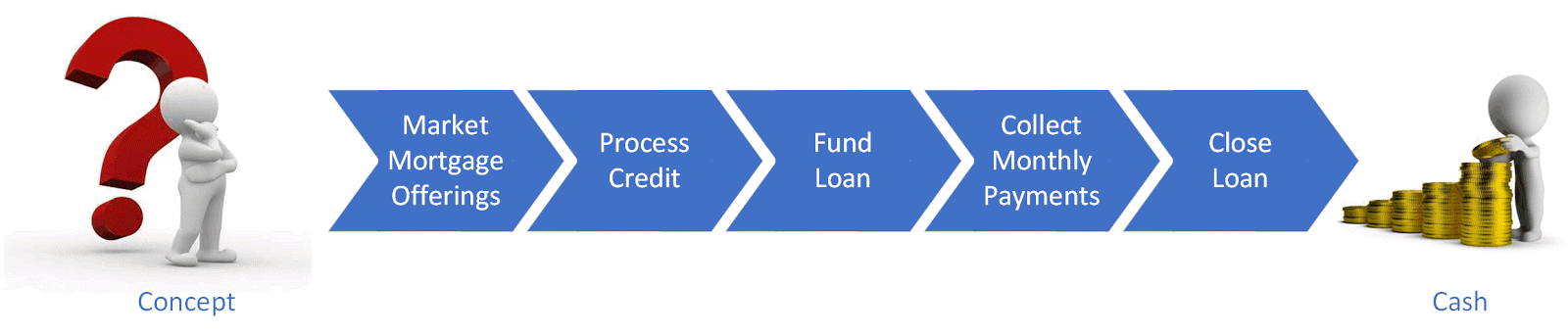
Before diving into this new learning, let’s review what a ‘value stream’ really is.  We start with understanding our Operational value streams, which are the set of interconnected steps that we go through to deliver value to our customers.  These value streams start with the concept, or the trigger or reason for delivering the value.  For example, when a potential or existing bank customer learns they are going to have their first child they may start thinking about purchasing a new house.  The trigger is the need for the value that the enterprise wants to provide.  The steps the enterprise goes through to deliver that value successfully to the customer are the operational value stream steps, such as marketing the mortgage offering, accepting the application, processing the customer’s credit and information, and providing and servicing the mortgage.  As the customer pays off the mortgage, we get to the other side of the operational value stream, the Cash.  This term is often used a bit ambiguously, but essentially means the fulfillment of the value stream to the satisfaction of the customer and the enterprise, resulting in both the customer and enterprise receiving benefit for the value.  Very often the actual money is transferred from customer to enterprise during the value stream (not always at the end), such as when the customer continues to pay the mortgage payments and the bank receives the mortgage principle and interest, but the operational value stream continues to flow as it services and eventually closes the mortgage.


While SAFe ® can be used to assist operational value streams to deliver, the sweet spot is really in supporting the Development value streams.  Development value streams are the set of steps we go through to support operational value stream steps.  They consist of the people, systems, and processes we use to support these operational steps.  For our mortgage example, there is most likely a credit review system for the credit approval step, and a set of systems that support the mortgage servicing steps. 

A Different Way of Thinking

SAFe ® was originally designed to organize Agile Release Trains around these systems to allow lean flow of value to increment and improve these systems.  E.g. If we want to improve the Credit Review System, we would organize an Agile Release Train around the development of this system.

However, as we learn about the application of the virtual organization of an ART to deliver value, we have discovered that very often this does not promote lean flow of value.  There are many reasons behind this issue, but the most prevalent is that very seldom does a single system alone support the Operational value stream step.  There are almost always other aspects, such as Compliance, Regulatory, Marketing, Sales, Legal, Research, etc.  To promote true lean flow, we need to rethink this paradigm and focus on all of the steps needed to improve these operational value stream steps.

The new way of thinking starts with a new way of identifying value streams.  Traditional SAFe guidance helps us find the Operational value streams, then discover the Systems that support these steps, and then to find the people that support these systems.  Dr Alan Ward defined Development value streams as the set of steps we go through to Create, Update or Deprecate Operational value stream steps, and he included all steps in this process.  Applying his work and this new way of thinking we look at all steps we go through to positively impact these Operational steps, such as Business, Infrastructure, Research, Marketing, Legal, Sales, etc. 

Lean Flow

Let’s discuss a simple example from manufacturing.  If a car maker is building cars, they are using an operational value stream to handle orders, bring in raw materials, create and assemble the parts, and ship and sell the car.  In manufacturing the steps to create a part are typically called a recipe, which includes all the specific steps to heat, form, stamp, etc the material to create a part, such as a hood.  The operational value stream step already is capable of producing this hood (via the recipe), but lets say we want to improve this hood.  What are the steps we would go through to improve the strength of the hood?  To improve the aerodynamic properties?  To reduce the amount of metal used in the production?  These steps are probably fairly similar, and would require the same people: designers, metallurgy specialists, marketing (for shape), compliance/legal (for safety), etc.  These people would go through a somewhat generic set of steps to improve the recipe to create the hood.  As they design, test, review, validate and confirm this new hood design, they update the Recipe, hence they are updating the Operational value stream step.  We then repeat these same steps for the next improvement we want to make to this Operational step, such as reduce the cost of the hood, make it lighter, etc.
Software and Hardware development is no different.  The end result is still that we want to improve the operational step, and we need a variety of people to do so.  In software we typically need the people in the SDLC process, but we also need people from Legal, Compliance, Marketing, Sales, Design, Infrastructure, etc to improve this Operational step.  Hardware/Firmware is similar in that we also need the people that actually create the product, but also all the other players that are needed to actually update the operational step.  These are the people we include in our virtual organization in the ART.

The Island

While coaching this method to a past client, I had the pleasure to work with a true Change Agent, Phil Purrington.  As Phil came to understand this method, he explained it this way.  “Imagine we have a deserted island, and we need to bring all the people needed to solve similar business problems to this island.  This has to include all the skills needed because, well, we’re on an island!”  This is a great visual as we understand the importance of having all the skills and experience needed on the ART to deliver value, and not just update a system.  Having this island mentality will definitely promote lean flow!

The Tradeoff’s

While this method creates true lean flow, it does not come without it’s cost as we have to make some tradeoff’s.  When we focus an ART on a specific system we can create a high level of architectural integrity and consistency, as the same people are always updating the same system.  Using this lean flow method we lose some of that singular focus on a system, but this can be easily overcome and compensated with good architectural design (loosely coupled, micro service based systems are great ways to relieve this issue), Community’s of Practice to distribute knowledge and proper usage, and clear strategic direction from leadership for a common vision to build upon.  In reality, less focus on organizing around the systems leads to better architectural development out of necessity.

A Different Focus

The result in focusing on this wider scope is that we reduce all the handoff’s and delays created when we have to wait for legal, compliance, marketing, or other inputs.  And, after all, that’s what we really want to focus on, Lean Flow. If there’s anything that the Toyota Production System, Don Rienertsen’s work, or any other lean expert will teach us, focusing on true lean flow of value will provide significant increases in value delivery.  And, after all, isn’t that what SAFe ® is all about?

Monday, October 15, 2018

Quality is Management's Responsibility


Yes, you read that right.  Quality is management’s responsibility.  Most agilist’s reading that statement would spit out their coffee and then declare “But, quality is the Team’s responsibility!”.  While that statement has merit, it is far more important to have a system in place that ensures high quality, and systems building is a management responsibility.  This is one area where traditional agile thinking meets with traditional lean thinking to create the best outcome.

Wisdom from Dr. Deming

Tim Stevens of IndustryWeek magazine had the privilege to be the last to interview Dr W. Edwards Deming about management’s responsibility.  One of the first questions Mr Stevens asked Dr Deming was “What can you say to IndustryWeek's readers that they might benefit from and apply to the way they are running their businesses?”  To which, Dr Deming replied “Management today does not know what its job is. In other words, [managers] don't understand their responsibilities. They don’t know the potential of their positions. And if they did, they don't have the required knowledge or abilities. There's no substitute for knowledge.”  Dr Deming continued with this explanation “Quality is the responsibility of the top people. Its origin is in the boardroom. They are the ones who decide.”.  Dr Deming, with all his experience and knowledge, wanted to illustrate that management’s (leadership’s) main responsibility is to build a system that creates and ensures quality.

Taking a Systems View


As a manager or leader one of your key roles is to create an environment that encourages rapid delivery of the right solutions for the customer.  This requires stepping back from the traditional command and control (telling people what to do) and instead focusing on creating a system that allows people to innovate while ensuring the right level of quality and governance is applied at the right points.  This is a difficult transition for most managers and leaders that have grown up in the Tayloristic work break down structure approach.  But what really creates value is the focused system that good people thrive in, not a failing system that good people try to work around.  In short, managers need to move from managing people to managing systems. 

Applying Systems Thinking to Ensure Quality

Taking this leap towards focusing on a system that ensures quality can be a daunting task.  I have found that starting with understanding the system is a critical first step.  To best understand a system, there is no substitute for a post-its-on-the-wall value stream mapping session.  (see my blog on the three reasons for value stream mapping in SAFe ® or some of Al Shalloway’s work on this subject).  For the sake of this article, let’s assume you have gone through this initial work (value stream mapping is an ongoing exercise), and have a decent understanding of how value flows through your system.  As a manager, your challenge is to begin to understand the bottlenecks at each state in the system, but also to understand how each state ensures Percent Complete and Accurate (%c&a).  One of your key objectives in applying systems thinking is to increase this %c&a at each critical transition or hand-off.  Definition of Done is an important tool to assist in this critical task.

The Importance of DoD in Increasing %c&a

True quality comes from a system that encourages transparency along each step of the process and incorporates the Andon chord approach to determine when/if to halt production when an issue is found.  In many cases the Dev Team does not have visibility or ability to change these systemic issues, but management can and should.  Using a clear Definition of Done (DoD) at specific points is a critical part of the quality system.  DoD’s are not checklists that we mindlessly go through, they are living contracts between teams, PO’s, PM’s, and the rest of the ART and its stakeholders as to our quality and accuracy validation.  If you are working in a scaled environment, the SAFe® recommendations on Definition of Done are a great starting point to improving the system to achieve Built In Quality. 

DoD is Measured at each Increment

In SAFe®, DoD is purposely used at various granular levels.  The team meets the Team DoD to ensure that the value added is worth demonstrating and reviewing.  The System Increment DoD ensures that it is integrated into the system and is worthy of Release consideration.  And the Release DoD ensures we have met our customer readiness and impact standards and are ready to put it in front of the customer.  Each Definition of Done is essentially asking “Are we done enough to go to the next state?”, which is a key part of our quality control to ensure our %C&A.
It is hugely wasteful to meet Release DoD on a story that may never be in the customers hands.  As Peter Drucker said "The worst thing we can do is do something well that should not have been done at all".  We increment towards a true state of ‘Done’ (in the customers hands and they are happy) through a set of ever expanding DoD increments.
The System needs to work even if a critical person is out.  Just because Dinesh is out sick today should not mean we have lesser quality that day.  The system should have its checkpoints that ensure that we are still following our agreed upon contract with the next step to consume the value.

Managements Role in DoD

As already stated, far too often teams are held accountable for quality when they have little to no ability to change the system that should be ensuring quality.  Agile teams are described as Self-Organizing and Self-Managing, but as described in another post, teams are not really self-managing.  We need management and leadership to provide teams with solid systems to work within, and these systems need to be built to deliver and ensure quality.  Built In Quality Is not just a phrase on the SAFe® Big Picture, it is a way of working and thinking that ensures quality at each step.

Iterative Growth on DoD

Building a DoD is not a one and done.  We need to start with a set of validations that we believe to be correct, measure the outcomes using this set of validations, and then iterate on the set.  We will almost certainly not get it right the first time, only through inspecting and adapting will we get to a solid set of DoD’s.  One good way to ensure that we are iterating on it is to capture any exceptions we deal with and determine if the DoD needs to be updated to prevent in the future.  E.g. If a system issue slips by our current DoD and into the customers hands, is there something missing from the DoD that would have caught this?  Whenever we are in crisis “it has to be fixed yesterday” mode we have to also capture the underlying data that allows us to improve the system once the crisis is over.
(1) Percent Complete and Accurate (%C&A).  A quality metric used to measure the degree to which work from an upstream supplier is determined by the downstream customer to be complete and accurate (or error free).  https://www.ksmartin.com/lean-terminology/


Wednesday, October 10, 2018

Crossing the Chasm with Scaled Agile


Like any successful business, Scaled Agile Inc. Has 'Crossed the Chasm' from Innovators, through Early Adopters, and has moved into the mainstream Early Majority stage. 
https://dwaynenesmith.com/book-review-template/
As experts like Geoffrey Moore and Ash Maurya pointed out at last week’s SAFe® Summit, it takes different leadership models to navigate your business in these different stages.  The 2018 SAFe® Summit pointed out just how well the Scaled Agile team is adjusting to this growth.

The week started off with the SPCT (SAFe® Program Consultant Trainer) session on Monday, where the SAFe® experts gathered to teach each other the subtle but significant changes to version 4.6.  The session capped off with an Epic generation session based on an SPCT view of the needs for 2019 and beyond.  The next day these ideas, focused on furthering the quality and effectiveness of training and the impact of SAFe® beyond the typical IT Systems Implementation, were presented to the partners for input and voting.  This is a great example of a company listening directly to its customers and key stakeholders. 
The release of version 4.6 was highlighted by the 5 Core Competencies: Lean Agile Leadership,  Team and Technical Agility, DevOps and Release on Demand, Business  Solutions and Lean Systems, and Lean Portfolio Management.  Each of these competencies highlight new learning and application of that knowledge to the framework.


https://www.weforum.org/agenda/2015/04/how-should-disrupted-businesses-plan-for-the-future/

The main conference was highlighted by Geoffrey Moore's great keynote on the 4 zones, and further illustrated how Scaled Agile is supporting the current body of knowledge with the existing framework (zones 1 & 2) while looking to the future (zones 3 & 4). 

In short, this is an exciting time to be part of this community.  It feels like we have come a long way already, but the week further highlighted how much more there is to learn and apply.  It was clear to me that Scaled Agile Inc has their Profit motive firmly moored to their Purpose motive.  Exciting tines indeed!

Thursday, August 2, 2018

A New Take on The 3 Questions


The ‘typical’ pattern of a DSU is focused on the 3 questions: What I did yesterday, What I plan to do today, and any Impediments I am facing.  Over emphasis on these 3 questions can easily kill agility and lean flow.  Here’s why.

What I Did Yesterday

This is far too often treated as a status report to the team, “I finished Story xyz” or “I’m still working on Story XYZ”.  Sharing this information is negating the value of collaboration outside of the DSU.  As a team we should be continuously working together through various best practices such as Pair Programming, limiting WIP, co-location, and transparency, that going into the DSU we already know what the others on the team were working on.  (Limiting WIP, which results in swarming on highest priority stories first, means there’s a good chance most/all of the rest of the team were working on the same story!) .  As a Scrum Master, you should be looking for this type of status report approach as a sign that the team is not really collaborating during the other 23 hours and 45 minutes since the last DSU.  This provides a great opportunity for process and team improvement, which is the core responsibility of every Scrum Master.
A better approach is to discuss what we did as a team yesterday.  A good practice is to review the team story board (or Kanban board) and have a general discussion on the highest priority stories that are in flight or soon to be taken on.  What have we learned about these stories?  What issues remain?  My personal advice is to change this first question to “What did we accomplish and learn as a team yesterday?”

What I Plan To Do Today

This is another area where we can far too easily create a team of individuals, rather than a true team working towards the same goal.  The plan for today (the next 24 hours on the Scrum diagram) needs to be a team plan, not an individual plan.  Understanding where we are at as a team towards Iteration Goals (and Team Objectives when working in SAFe®) is critical information.
Using a North American Football reference (the NFL in the USA)  is a good way to understand this concept.  When an NFL team runs an offensive play, attempting to move the ball down the field or potentially score points, after the play they all have a clear idea of how well the play went.  When they return to the ‘huddle’ (players gathered together in a circle to discuss what to do next) after the play, they only have 45 seconds to run the next play, so they don’t take a significant amount of time to discuss how the last play worked.  They all know if they gained yardage, if the play was successful, etc.  There may be nuances that are important (one player to another: “I was open for that play”) that are shared, but it quickly focuses on what to do next.  Was the last play a run?  Was it successful?  Let’s run the ball again!
A DSU is very similar to an NFL huddle.  The team should get back together and should already know how the last ‘play’ (the last 24 hours effort) went, and what the result was.  The DSU can then quickly focus on the best plan for the next 24 hours (or until the next DSU).  My recommendation for the second question is “What is our plan until the next DSU?”  This can include things like “Dinesh, can you pair with me on this part of the effort?”  “Dave, I’m going to need help with this test scenario, can we start right after the DSU?”.  A clear sign for a Scum Master that the DSU was effective is that the team has a shared plan walking out of the DSU, and each team member knows how they are going to contribute.   If this is not happening it’s another opportunity for team process improvement.


What are my Impediments?

This third area is also critical to keep at the team level, rather than an individual level.  The true concept of a team means that if one has an impediment, the whole team has an impediment.  Going back to the NFL huddle concept, if a wide receiver knows that the next play called means they are needed to run a deep route of 80 yards, and they just ran 80 yards and are too winded to complete this, they let the team know this isn’t the right play to run.  They share the impediment with the team, and the team takes on the impediment as one.  This is the same for an agile team; when there is an impediment for one it is an impediment for all, and it needs a team solution.  This approach is carried out in so many other scenarios, such as the military, but we tend to shrink away from this when it comes to agile teams.
My recommendation on this third question is just a bit modified, and then extended.  “What impediments do we have to our plan?  What can we do to adjust our plan to compensate or mitigate the impediment?” 

The End Result

Following these simple changes results in a DSU that is team focused, identifies improvement issues, and creates a collective ownership approach to planning and overcoming impediments.  Collaboration is critical amongst an agile team, but during the DSU the shared input into a new or adjusted plan until the next DSU is even more important.


Wednesday, July 18, 2018

Understanding the Components of Economic Sequencing (WSJF)


Weighted Shortest Job Firstor as I like to call it, Economic Sequencing, is a critical tool in properly focusing on the right problem to solve next. Far too often I work with executive leadership teams to discuss their strategic goals, and they give me a list of around ten ‘priorities’. My job is to help them understand that if you have 10 priorities, you have no priority. (The word Priority was never pluralized until around the late 18th century, it’s based on the Latin ‘Prior’, meaning first). Having that one key business initiative, with the other initiatives being clarified as ‘Important, but not the priority’ is critical to limiting Work In Progress (WIP) and delivering real value. Without this clear sequencing based on projected economic outcomes we end up working on too many things at once, and delayed or prevented delivery on the most important thing.  Don Reinertsen’s work (among others) has shown that we get more done in the long run by focusing on one thing at a time.

WSJF in the SAFe® world utilizes proxy values for the Cost of Delay measurements that Rienertsen advocates.  (Note: Outside of the SAFe® world this is typically referred to as CD3, or Cost of Delay Divided by Duration).  These 3 CoD factors, User/Business Value, Time Criticality, and Risk Reduction/Opportunity Enablement, are very often confused or misunderstood, resulting in watered down impact of the process. I’m going to use the analogy of a sail boat to help illustrate these three elements.

Here’s the scenario.  We have a sailboat that we want to sell to a customer, but it has some issues.  The paint is peeling, the motor needs work, and there is a leak in the hull that we have yet to find.  Which problem should we correct first?  Let’s use relative sizing with modified Fibonacci to determine the CoD factors for this effort.


Let’s start with the User/Business Value (UBV) aspect for each effort.  Looking at the boat peeling in the sun, it doesn’t look very pretty, so we probably say that the Paint initiative is our highest issue.  But, what’s our lowest UBV?  Probably the motor, since the motor does run, so let’s assign that our 1.  Looking at the other two items relatively, we then decide that the Leak effort is probably a 3 since it’s causing the boat to settle lower in the water.  Based on how bad the paint looks, we are putting the Paint effort at a 13.  So we now have, in relative UBV ranking, Motor = 1, Leak = 3, Paint = 13.

Time Criticality (TC) is one of the confusing ones for most people, as they tend to think only of deadlines.  The truth is, unless you are building systems that have to align with the lunar cycles or other unchangeable events, deadlines are created by someone, somewhere.  We have to look at time criticality as the loss of potential value over time more than by deadlines, as that is the true impact to ability to deliver the most valuable thing first.  So, where do our 3 initiatives fit in with TC?  Since our motor is running now, and we believe it will continue to run, we are going to put this as our 1.  This does not mean it has no time criticality, only that of our given opportunities it has the least amount of TC.  The paint is peeling, but we are not in the rainy season, so our TC for Paint is relatively low at a 3.  However, the leak is getting worse, and we can’t fix a motor or paint a boat if it’s on the bottom of the ocean, so our TC for the Leak is 13.  The potential loss of value increases greatly the longer we delay.  So, our TC is Motor = 1, Paint = 3, and Leak = 13.

Last comes the Risk Reduction and Opportunity Enablement (RR/OE).  These two elements work well as a combined value since rarely are we able to reduce risk and open new opportunities at the same time.  Risk Reduction increases when we see an opportunity to lower a potential risk to the enterprise or the customer.  In our case, the risk of the Leak is greater than the risk of the Motor failing, but both are relatively high concerns. The Paint has little risk, and while there is an opportunity for increased margin on the sale of the boat, based on greater interest and competition among buyers, it is still our lowest RR/OE value.  Based on this understanding, we are assigning RR/OE as Paint = 1, Motor = 5 and Leak = 13. 
eater than the risk of the Motor failing, but both are relatively high concerns.
Now we can add these proxy values up to get to our forecasted Cost of Delay. 
Paint = UBV (13) + TC(3) + RR/OE(1) = 17
Leak = UBV(3) + TC(13) + RR/OE(13) = 29
Motor = UBV(1) + TC(1) + RR/OE(5) = 7

This tells us that our greatest cost of delay is in not fixing the leak, but it still doesn’t tell us which one we should focus on first.  We have to add in the cost of implementing these initiatives to the equation in the form of Job Size (JS).  This is also a relative number based on our understanding of the complexity of the effort, the uncertainty of the solution, the knowledge (or lack thereof) in the issue, and the over amount of effort and complexity.  Since we are familiar with the process of stripping the paint, prepping the hull, and repainting, but it’s a fair amount of work, we are thinking the Paint would be the largest job size.  The Motor should be a simple fix, but due to our lack of mechanical skills, the Motor has a great deal of complexity, so we are thinking this falls some just below the Paint.  The cause of the leak is readily apparent, and does not seem too difficult, so it’s our lowest job size.   That gives us a Job Size of Leak = 1, Motor = 5 and Paint = 8.

Applying the Weighted Shortest Job Size equation of WSJF = COD (UBV + TC + RROE) / JS results in this ranking:
Leak = CoD(29) / JS(1) = 29
Paint = CoD(17) / JS(8) = 2.125
Motor = CoD(7) / JS(5) = 1.4
This clearly tells us (by a wide margin) that despite how bad the boat looks, the first thing we should focus on is the leak.  It may be hidden from view (eg. Technical debt, architectural or infrastructure needs) but focusing on the Leak first will result in the greatest economic outcome.  This type of data can greatly help with the typical ‘prioritization’ methods that usually result in HiPPO decisions (Highest Paid Persons Opinion), and instead use localized information to create the greatest benefit.


The Outcome Clock: Aligning to Metrics That Matter

    Dwayne Stroman, Leaning Agile, Wm. Frank Dea, USAA   Introduction: Why Outcome Metrics Matter Too often, teams and leaders a...